

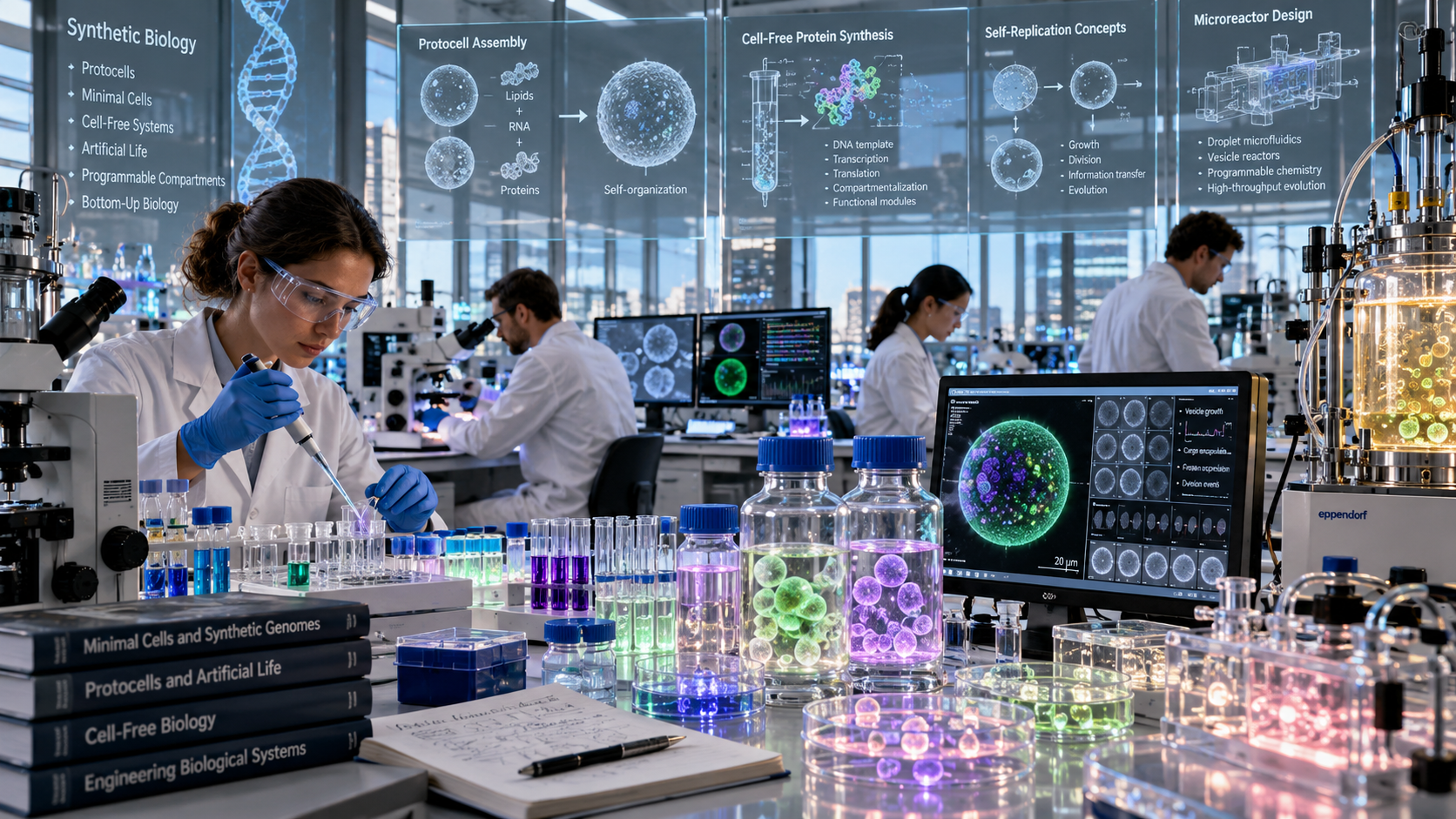
Why Life Has Not Been Made in a Laboratory
What I believe about where life comes from
By David LaPoint
October 2026
In "A Physical Device That Works in the Spiritual Realm" I explained why I believe the spiritual realm is the foundation of the physical world: the visible came from the unseen, and the unseen is holding it up right now. This piece takes that one step further. I believe life itself is anchored in the spiritual realm, and I believe that is the reason no laboratory has ever made a living thing out of non-living material.
This is what I believe and why. I cannot prove it. But I think the facts line up with it better than with the alternative, and I want to show you why.

What has actually been done
Scientists have been trying to make life from chemicals for a long time, and it is worth being exact about what they have and have not done, because the news headlines are usually not.
1828. Friedrich Wöhler made urea, a chemical that living bodies produce, from non-living materials. This settled that the chemicals of life can be made without a living thing. It said nothing about life itself.
1952. Stanley Miller ran electric sparks through gases thought to resemble the early Earth and got amino acids, some of the building blocks of proteins. Building blocks, not a building, and nowhere near a living cell.
2010. Craig Venter's team chemically synthesized a complete bacterial genome and put it into a living cell of a related species. The cell took up the new genome, its original genome was lost, and it "booted up" and ran on the man-made one. The genome was man-made. The cell was not. It was already alive, and it stayed alive while its instructions were swapped. [1]
2016. The same group stripped that genome down to the smallest set of genes that would still keep the cell going, about 473. Again, this was done inside a cell that was already living. [2]
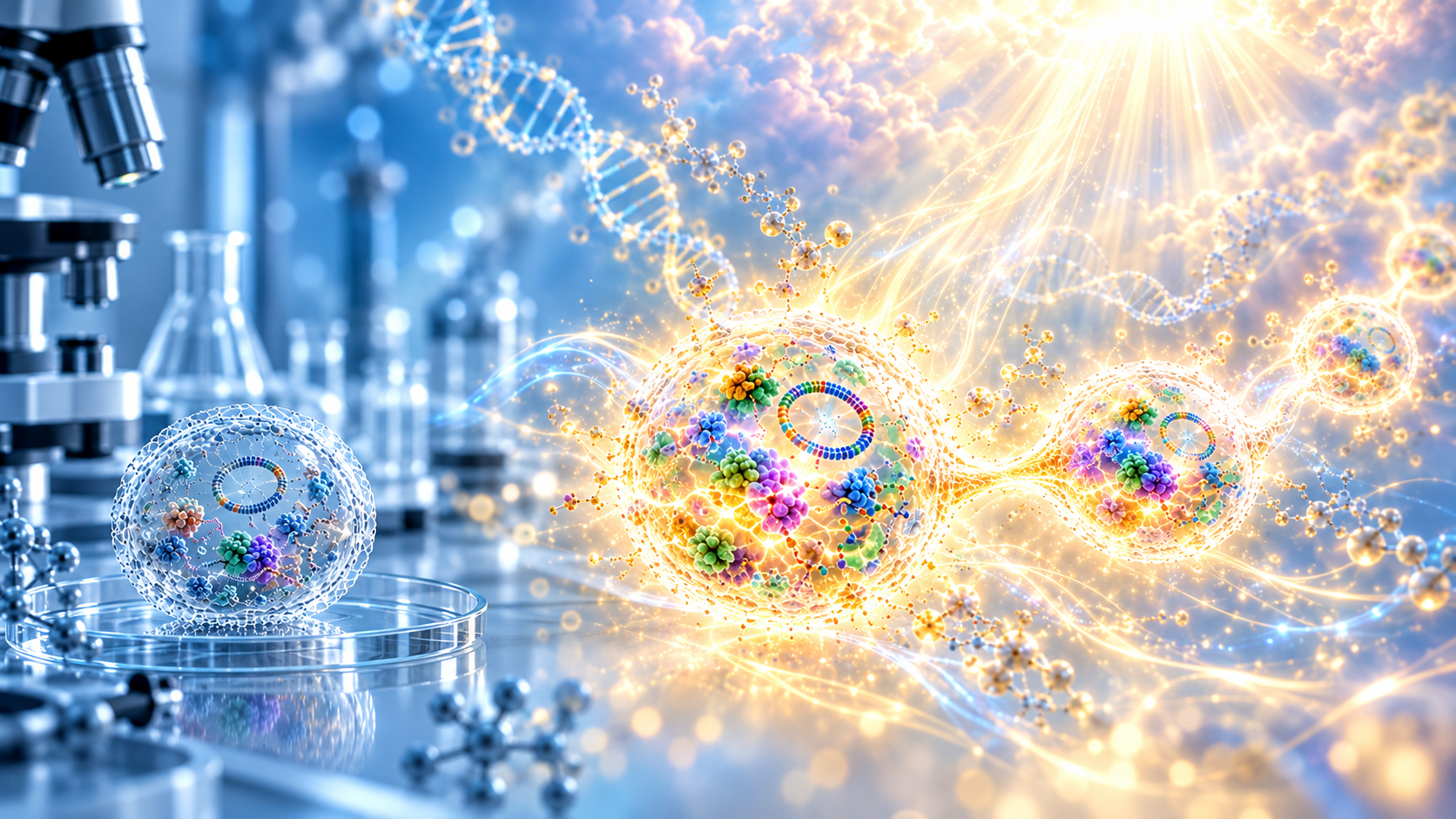
July 2026. A team at the University of Minnesota announced what they call SpudCell, the closest anyone has come. They assembled it from purified parts: DNA, enzymes, ribosomes, and a fat-molecule membrane. It takes in nutrients, grows, copies its DNA, and divides. [3][4]
The real SpudCell Story
SpudCell deserves a closer look, because it is the strongest case anyone can make, and the people who built it are careful about what they claim. It cannot make its own ribosomes, the machines that build proteins; those are taken from living E. coli bacteria and fed to it in little packages. The enzymes it runs on come from E. coli genes too. The ribosomes wear out and it cannot replace them, so after about five to ten divisions it stops. It divides when proteins crowd the membrane until it splits, but that is inefficient, and the Science report says the team also separated the cells mechanically to get repeated rounds. By the fifth division only about a third of the cells still had a complete genome. [3][4][5]
The lead scientist, Kate Adamala, calls it an incredibly wimpy organism that does little besides eat and occasionally make a daughter cell, and she has said she would call it living only if it replicated indefinitely and could evolve on its own. Her colleagues in the field say the same thing: a cell has been constructed, but life has not been created. The work is a preprint that has not yet passed peer review. [3][5][6]
So here is where things stand, as far as I can verify. Every lab-made "cell" to date either started from a cell that was already alive, or borrowed its working parts from one. And the one that comes closest still depends on machinery taken from living organisms and runs down and stops.
Louis Pasteur showed in 1862 that the microorganisms appearing in nutrient broths came from existing microorganisms rather than arising on their own in the broth. His experiments did not test every condition under which life might begin, and I am not claiming they did. But in the century and a half since, with every microscope and instrument that has been invented, nobody has ever observed life come from non-life. Not once. The idea that it happened on its own in the distant past is a hypothesis about something nobody saw. The thing people have actually seen, every time, is life coming from life.
What I believe this shows
The usual explanation is that life is just very complicated, and we have not finished working out the recipe. Get the parts right, get the arrangement right, and it will run. I do not believe that. SpudCell reproduces several remarkable functions of living cells, but it still depends on machinery taken from existing organisms and cannot sustain itself indefinitely. I believe the deeper question remains whether completing the chemistry would be enough to produce life itself.
I believe what is missing is life itself. Not a molecule, not a field, not a current that could be measured and added back in. I believe life is something a body is given, not something a body does once its chemistry is arranged. We have a plain word for it: a life force. I believe it comes from the spiritual realm, the same unseen realm that Scripture says the whole physical world is held up by.
This fits what I said in the earlier piece. Colossians 1:17 and Hebrews 1:3 both use present-tense language: all things hold together in Him, He is carrying all things right now. If the existence of every atom is being held up from the unseen at every moment, then it makes sense that the thing which makes a body alive is also given from there, moment by moment, and is not a property the atoms have on their own.
And that would explain the laboratory record exactly. We can rearrange matter. We are getting very good at it. But our ability to arrange physical matter does not give us authority to supply the life that comes from God. So the only way we have ever gotten a living thing is from another living thing: breeding, cloning, growing cells in a dish, or, as in these experiments, borrowing parts taken from living organisms. Life gets passed along. It does not get manufactured.
I want to be clear that this goes beyond complexity. Suppose someday a lab assembled every molecule of a bacterium in its exact place, every one, with nothing borrowed from a living cell. I do not believe it would be alive. I believe it would be a complete, correct, dead cell, the way a body a minute after death is complete and correct and dead. The material is all still there. What left was never material.
What Scripture says
I am not reading this into the text. The text says it, and it says it repeatedly, in the same order every time: the material is there first, and it is not alive until something is given to it from God.
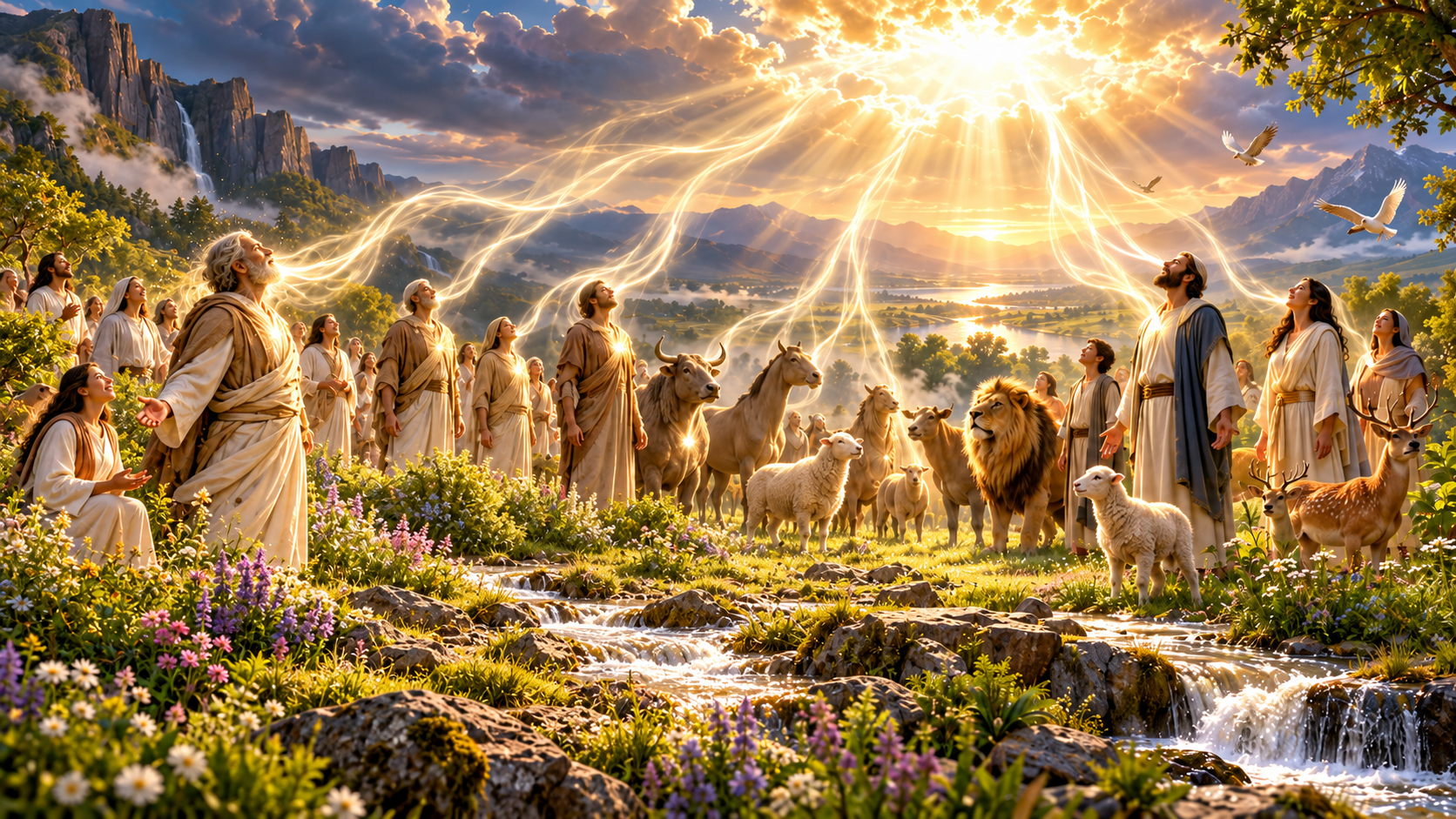
Genesis 2:7. God formed the man from the dust of the ground and breathed into his nostrils the breath of life (nishmat chayyim), and the man became a living being (nephesh chayyah). The body was formed first. It was dust shaped into a man. It became living when the breath of life went into it, and not before.
This is not only about man. Genesis 7:22 speaks of everything on dry land "in whose nostrils was the breath of the spirit of life," meaning the animals too. The verse speaks of land creatures; extending it to every form of life is my own application, but the text does treat the breath of life as something those creatures were given, not something they had on their own.
Job says it directly. Job 33:4: the Spirit of God made me, and the breath of the Almighty gives me life. And Job 34:14–15: if He were to set His heart on it and gather to Himself His spirit and His breath, all flesh would perish together and man would return to dust. Psalm 104:29–30 says the same of every creature: You take away their breath, they die and return to their dust; You send out Your Spirit, they are created. Notice that this is not a one-time spark at the beginning. It is ongoing. Life is given continually, and if it were withdrawn, everything living would die at once. That is the present-tense holding together of Colossians 1:17, applied to life.
Ecclesiastes 12:7 describes death from the other end: the dust returns to the earth as it was, and the spirit (ruach) returns to God who gave it. At death the material stays behind. What leaves is the thing that was given, and it goes back to where it came from.
The clearest picture of all is Ezekiel 37. Ezekiel is set down in a valley of dry bones and told to prophesy to them. The bones come together, bone to bone. Sinews come on them, then flesh, then skin covers them. Complete bodies, fully assembled, every part in place. And then verse 8: "but there was no breath in them." Only when Ezekiel prophesies to the breath (ruach, the same word as spirit and wind), and it comes into them from outside, do they live and stand up.
The vision is about the restoration of Israel; verse 11 says so. But its imagery shows exactly the distinction I am describing: bodies are formed before breath enters them, and forming them is not the same as making them live. The structure is finished and correct, and it is not alive, and nothing about the structure can make it alive. Life has to enter it.
The New Testament keeps the same order. John 6:63: it is the Spirit that gives life; the flesh is of no use at all. James 2:26: the body apart from the spirit is dead. When Jesus raised Jairus's daughter, Luke 8:55 says her spirit returned and she got up at once; her body was there the whole time, and it was the return of the spirit that made it alive again. Acts 17:25 says God gives to all life and breath and everything else.
Put those together and the pattern is unmistakable. Scripture never says that matter becomes alive by its own arrangement. It says that life is given to matter, that it is given by God, that it is given from the unseen, that it is sustained continually, and that at death it returns to where it came from. That is exactly what I mean by a life force anchored in the spiritual realm.
What I am and am not claiming
A scientist would say that the failure to make life so far shows it is an unsolved problem, not an impossible one, and that is a fair point. I grant it. Not having done something is not proof it cannot be done. If someday a laboratory makes a cell from non-living chemicals, with nothing borrowed from a living thing, that replicates indefinitely and evolves on its own, then I will have been wrong, and I will say so. I do not believe that will happen, but I am not going to hide from the test.
But I want to take on something the lead scientist said when the work was announced: that it shows the basic functions of life do not need a "mysterious magical spark." [7] One philosopher went further and called it a compelling argument against anyone who thinks something immaterial breathes life into matter. [6] I see their findings as consistent with my position, and I want to spell out why.
Look at what it took. The ribosomes came out of living E. coli. The enzymes are purified from E. coli. The feeding, the growth, the division, every function they point to, ran on parts taken from organisms that were already alive. The cell cannot make its own replacement ribosomes. It also requires externally supplied nutrients and additional components to support division. When the borrowed parts wear out, it stops functioning, because there is nothing in it that can carry on. [3][5][8]
Notice how carefully that sentence was worded. It says the basic functions of life do not need a spark. It does not say life does not need one, and it could not, because they do not have life. They have growth and replication running for a few generations on borrowed machinery. Reproducing growth and replication does not reach the question I am asking: whether life itself depends on something beyond its physical machinery.
The team's own list of what is still missing is all machinery: making ribosomes, passing on the genome reliably, feeding itself. [8] That is what I think their result shows: not that the spark is unnecessary, but that it is not anywhere on their list. I believe that when the last piece of that machinery is built, the cell will still be missing the one thing that was never machinery.
The chemistry of life is not beyond reach; Wöhler settled that in 1828. Life is not a molecule. This research will keep teaching us how the machinery of the body works. I am only saying what I believe the machinery is not: it is not what makes the body alive.
Conclusion
Hebrews 11:3 says the visible world did not come from what is visible. I believe the same is true of life. Every living thing anyone has ever seen came from a living thing, all the way back, and I believe that chain ends not in a chemical accident but in the breath of life given by God from the unseen. That is why we can study life endlessly, understand it better every year, assemble its parts with growing skill, and still not make it. We are working in the physical realm. Life is anchored in the spiritual one, and that is not a realm we command.
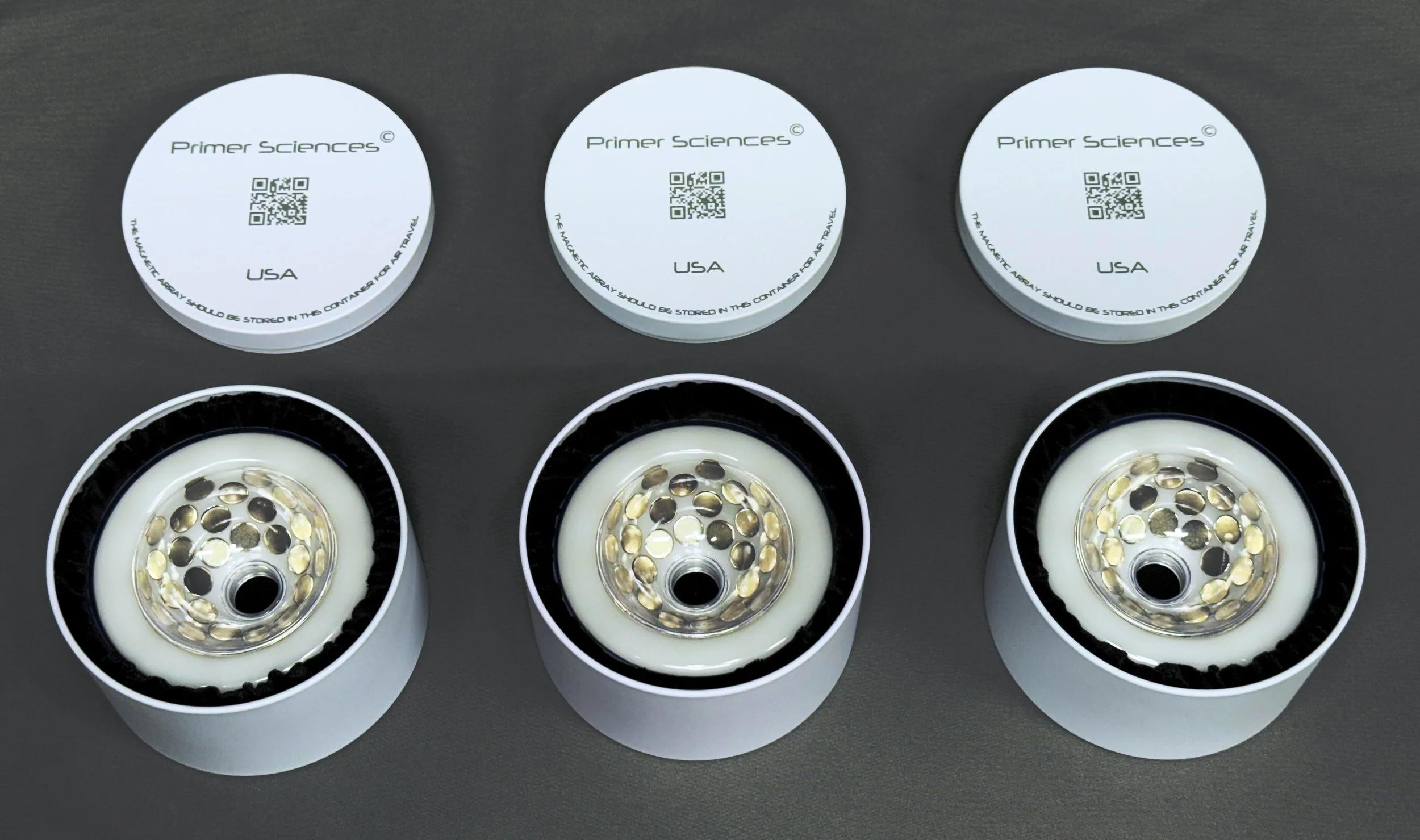
That brings me back to the PFE25™. These are two separate beliefs of mine, and I want to put them side by side. In the earlier piece I explained why I believe the PFE25™ is a physical device that works in the spiritual realm. In this piece I have explained why I believe life itself is anchored in that same realm. Put those two together and the PFE25™ works in the very place life is given from, and that changes how I think about it.
Not every matter a person faces is physical. Some are spiritual, even when they feel physical, and a spiritual matter calls for a spiritual approach. I believe that is where the PFE25™ belongs.
Twenty years of research with magnetic fields is what brought me to that conclusion, and it took me most of those years to see it. I still say what I said before. The PFE25™ belongs alongside seeking God and caring for the body. It does not replace either, or appropriate medical care.
Sources
1. Gibson, D. G., et al. "Creation of a Bacterial Cell Controlled by a Chemically Synthesized Genome." Science 329 (2010): 52–56.
2. Hutchison, C. A., et al. "Design and Synthesis of a Minimal Bacterial Genome." Science 351 (2016).
3. CNN, "Scientists say they have built a cell from scratch for the first time," July 1, 2026. https://www.cnn.com/2026/07/01/science/synthetic-cell-research
4. Science, "Lab-created 'SpudCell' marks 'stunning' step toward building life from scratch," July 2026. https://www.science.org/content/article/lab-created-spudcell-marks-major-step-toward-building-life-scratch
5. Singularity Hub, "This Synthetic Cell Grows, Copies Its DNA, and Produces Offspring—But It Isn't Alive," July 9, 2026. https://singularityhub.com/2026/07/09/this-synthetic-cell-grows-copies-its-dna-and-produces-offspring-but-it-isnt-alive/
6. Smithsonian Magazine, "Scientists Say They've Made Cells That Feed, Grow and Reproduce," July 2026. https://www.smithsonianmag.com/smart-news/scientists-say-theyve-made-cells-that-feed-grow-and-reproduce-bringing-them-one-step-closer-to-building-life-from-scratch-180989070/